
Babyn Yar Holocaust Memorial Centre is seeking volunteers to help preserve Ukraine’s archival heritage
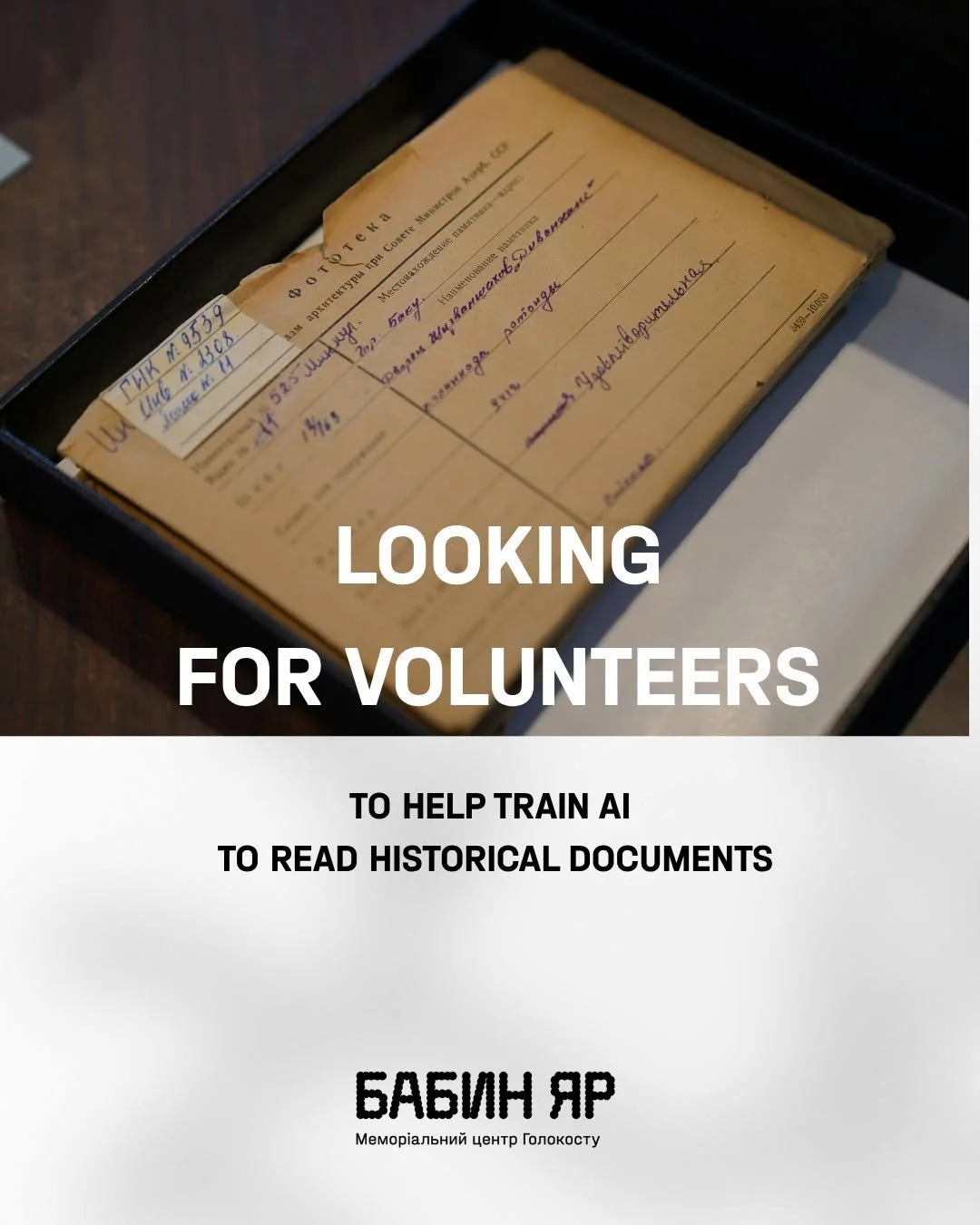
Millions of handwritten documents are stored in archives across Ukraine — letters, applications, lists and many other records. Over time, these materials have become increasingly difficult to read due to complex handwriting, faded ink and the use of regional dialects. Searching for specific information without automated tools is also extremely time‑consuming. As a result, important historical evidence risks remaining undiscovered or even being lost forever.
To safeguard these documents for future generations, the Babyn Yar Holocaust Memorial Centre is developing an artificial intelligence model capable of recognising handwritten texts in Cyrillic, Latin script, Hebrew and Yiddish. The model has already processed more than 50,000 documents.
Once transcribed, the text becomes searchable within the Centre’s system, allowing researchers to locate documents using any word or phrase. At present, the model’s accuracy ranges between 60–80%, and further training is essential. To achieve this, the Centre is inviting volunteers from around the world to help verify and refine the AI‑generated transcriptions using materials from its extensive online archive.
What will volunteers do?
Work with documents from the Centre’s online archive, which contains more than 10 million records.
Compare AI‑generated transcriptions with the original handwritten documents and correct any errors.
Can I volunteer from abroad?
Yes. Volunteers from anywhere in the world are welcome. All you need is internet access, a few free hours, and a willingness to support the project.
Do I need previous experience working with archives?
No. The project team will provide all necessary guidance and training.
▶︎ Learn more about the project:
https://babynyar.org/news/shukaiemo-volonteriv-dlia-zberezhennia-arkhivnoi-pamiati-ukrainy/
▶︎ Become a volunteer:
Help train AI to read handwritten documents — complete the application form and join the project: https://myrod.ai/form/volunteer
About the Babyn Yar Holocaust Memorial Centre
Babyn Yar is a ravine in Kyiv and one of the most tragic sites of the Second World War. It became the location of one of the largest massacres carried out by Nazi forces and is now recognised as a defining symbol of the Holocaust in Eastern Europe.
Between 1941 and 1943, Nazi units shot between 70,000 and 100,000 people at Babyn Yar — including almost the entire Jewish population of Kyiv. In just two days, 29–30 September 1941, 33,771 people were executed. Other victims included Roma, Soviet prisoners of war, patients of the psychiatric hospital, Ukrainian nationalists, and civilians.
The Babyn Yar Holocaust Memorial Centre was established in Kyiv in 2016 to create a unified museum space and to research, preserve and share knowledge about the tragedy of Babyn Yar. In 2026, the Centre marks its tenth anniversary.
What the Centre does today
Digitising archival documents. The Centre digitises materials from archives across Ukraine, especially in frontline regions where documents are at risk of destruction. It also helps preserve unique written artefacts, such as 14th‑century Torah scrolls and manuscripts from the 15th–17th centuries. Its digital archive now contains over 10 million documents, making it one of the largest collections in Eastern Europe.
Restoring names and biographies. The Centre is compiling the most complete and accurate list of victims of Babyn Yar, identifying previously unknown individuals and reconstructing their life stories. The catalogue currently includes 30,005 names.
Training AI to read handwritten documents. The Centre is developing the first AI model trained not on open internet data, but on verified archival documents. This will transform the archive from a digital repository into a living research infrastructure where history becomes accessible, evidence‑based and open to the world.
Publishing academic research. The Centre issues the scholarly journal Eastern European Holocaust Studies, dedicated to Holocaust history.
Preserving and expanding the museum collection. The museum holds more than 1,000 historical artefacts and over 32,000 photographs documenting Jewish life in Ukraine and Eastern Europe in the 19th–20th centuries, the Holocaust and the Second World War. Many photographs are more than a century old. Each image is digitised, catalogued and, where necessary, digitally restored to ensure long‑term preservation. These materials support exhibitions, publications and educational projects.
Follow the Babyn Yar Holocaust Memorial Centre on Facebook: https://www.facebook.com/babynyar.memorial
